
The Statistics of Synchronicity, Part 1
A light, first look into the physics experiment John Stewart Bell devised to study the quantum mechanics of Einstein’s local realism hypothesis.

In 1964, John S. Bell devised a thought experiment evaluating the hidden variables Einstein had espoused, some three decades earlier, to barter synchronicity, which he considered “too miraculous” (Rucker, 1984/1985), for determinism. Indeed, the fulcrum—pun intended—of that barter ensues from a paradox we know as the Einstein-Podolsky-Rosen (EPR) paradox, which goes as follows:
In concert with quantum mechanics, and no matter the separation distance, when two particles approach each other, they each become instantaneously and reciprocally bound by the other’s influence. Now, Einstein’s theory of relativity contends that no signal, nor anything else for that matter, could defeat the speed of light in a race. That axiom diverges, however, from what one might expect of a “coincidence,” such as the one below, in Figure 1.
Figure 1
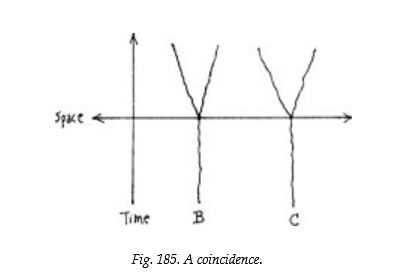
Why might that be, though? More on that in Part 2.
References
Rucker, R. (1985). La quatrième dimension (C. Jeanmougin, Trans.). Éditions du Seuil. (Original work published 1984)